
Fortune's Weave Growth Rates: Read Stats, Classes, and Builds
Use Nintendo's visible-growth example to read character development without mistaking current stats, BLD, Luck, weapon choices, or unverified tables for confirmed mechanics.
Short answer: Nintendo confirms that Fire Emblem: Fortune's Weave shows each character's growth rate, helping players judge which basic stats—such as Strength or Speed—are more likely to increase. That makes the screen a planning tool, not a promise about the next level-up, a full character table, or a universal answer to BLD, Luck, and weapon questions. Start with the visible breakdown in your own save, then choose a class and loadout for the next map's job.
Nintendo's public example shows Cai's Spd growth 55 as Base Value 45 + Class 10. It is the clearest official evidence for how to read one displayed growth value. It does not establish every character's rates, every class modifier, or a probability formula. This guide keeps that distinction visible so a sensible training decision does not turn into an invented mechanic.
What growth rates can tell you
Nintendo's Ask the Developer Vol. 23, Part 2 says that, for the first time in the series, each character's growth rate is visible. The developers describe those values as a way to see which basic stats, including Strength and Speed, are more likely to increase. That is enough to support a careful decision: compare characters' visible development directions before investing training, certification time, or scarce equipment.
It is not enough to turn a growth value into a forecast. A displayed value does not tell you what happens on the next level, how many points a stat will gain over a chapter, or whether a specific build will outperform another on every map. In particular, Nintendo's published material does not provide a complete all-character growth table, a fixed-growth setting, a level-up reroll rule, or a public combat formula for every stat.
Use growth rates as one part of a three-part reading:
- Current screen: What are the unit's present stats, equipped items, class, and visible battle values right now?
- Growth direction: Which basic stats does the game indicate are more likely to increase as the unit develops?
- Map decision: What does the next battle actually require—damage, a follow-up, survival, range, positioning, or a specific class and weapon option?
The third question matters because a promising long-term direction does not remove a current penalty. A unit can have an encouraging Speed growth display and still need a different weapon, safer tile, support partner, or class path for the immediate map. Conversely, a unit with a less obvious growth direction can still solve a map-specific task through positioning, range, terrain, Combat Arts, or a carefully chosen loadout.
How to read the official Cai example
Nintendo's official interface image shows Cai as an Ornius Rider. In the Growth Rate section, the selected Speed field is shown as 55, with a visible breakdown of Base Value 45 and Class 10. The current Speed elsewhere on that screen is 11. Those are different kinds of information: the 11 is a current displayed stat in that interface state; the 55 is a growth value with a shown contribution.
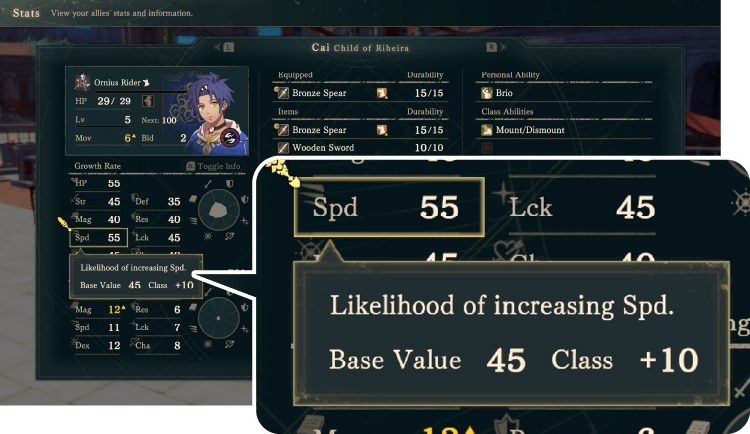
The useful habit is to read the labels before comparing numbers. Record the character, class, game version, selected stat, displayed total, and each visible contribution. If you change class, repeat the same observation rather than assuming the class contribution always works the same way. If the UI changes after a patch, keep the screenshot or note with the version shown on the title screen.
The interview also says characters can generally change into any class when they meet the skill requirements and pass certification exams. That supports experimentation, but it does not make every class path equally good. A character may be trained as a mage for one player and a mounted unit for another; the better fit depends on the visible direction, available certification requirements, weapon access, map objective, and the result shown on the live battle screen.
A practical growth-rate reading workflow
Use this workflow whenever you are deciding whether to train, certify, reclass, or equip a character. It deliberately separates facts on the screen from assumptions imported from older Fire Emblem games.
1. State the next-map job
Write one sentence before opening menus. Examples: “This unit must finish an exposed target,” “this unit must survive enemy phase at a chokepoint,” or “this unit needs reach to assist a route objective.” The statement is not a stat formula. It is a way to avoid optimizing a number with no battlefield purpose.
For an offensive job, the relevant live result might be enough damage, range, hit reliability, or a follow-up. For a defensive job, it may be survival, positioning, and the ability to use a safer option. A utility job can favor movement, a usable weapon type, or access to a skill over the largest displayed growth figure. The official material confirms tactical, grid-based battles and multiple character-development options; it does not publish a single universal priority list.
2. Capture a baseline
Before making a change, note the current character, class, level, basic stats visible on the screen, equipped weapon and accessory, and game version. Then save or screenshot the relevant menu if your system allows it. A baseline makes an honest comparison possible: you can tell whether the change came from the class, an item, a temporary effect, map state, or your own memory.
Do not write down only the growth value. The current screen tells you what the unit can do now; the growth screen tells you a longer-term direction. Those numbers can both matter without being interchangeable.
3. Read the growth field and its visible parts
Select the stat in the Growth Rate section and copy only what the game shows. The Cai example establishes that one displayed Speed total can include Base Value and Class parts. It does not establish that every field has the same labels, that all modifiers are visible, or that any number represents an exact percentage. If your own interface does not display a percent sign, do not add one in notes or guides.
For a growth-based comparison, ask: does this character's visible direction support the job I expect them to do over several levels? That question is more defensible than “which character is guaranteed to cap this stat?” because Nintendo has not published the full table or the underlying roll system in the sources used here.
4. Compare class access separately
Certification requirements and classes answer a different question from growths: what path can the character take, and what does that path let the character do? Consult the class and certification guide before treating a desired class as available. The official interview supports general class freedom after requirements and exams; it does not prove that every character, weapon, spell, skill, or class combination is available at every story point.
When evaluating a class, make two notes. First, record what the growth screen visibly changes, if anything. Second, record the practical effect you can see: mobility, a usable option, a requirement met, or a loadout that fits the next objective. Keeping the notes separate prevents a class contribution from being confused with a weapon rule or a current combat result.
5. Test the equipped result
After a class or item change, revisit the same relevant battle values. Nintendo's official store page describes strategic turn-based combat where units are guided on a grid, and its overview presents classes, weapons, terrain, positioning, Combat Arts, and Blaze Arts as part of the tactical setting. That supports testing a plan in context. It does not license us to invent an exact damage, hit, Weight, or Luck formula.
The safest question is concrete: “Did this exact change help the unit perform the stated next-map job?” Keep the unit, class, map state, and version as stable as possible when testing one piece of equipment. If several variables change at once, record that the result is a loadout observation, not proof of a hidden mechanic.
Choosing attributes at different stages
Growth planning changes as information changes. Early in a playthrough, you may have fewer classes, fewer weapons, and less certainty about which maps or recruits are ahead. Later, you can compare actual screens and map requirements. The goal is not to force a character into a final build before the game has shown the choices.
Early: protect flexibility
At the start, use visible growth information to identify possibilities rather than a permanent role. A Strength or Speed direction can suggest which basic stats may deserve attention, but it does not make the unit's immediate current values irrelevant. Avoid spending scarce resources solely because an older-series guide says a familiar stat “always” works in a particular way.
Focus on what is verified: the character's current screen, the available certification requirements, and the next map. If the route offers several valid choices, leave yourself a note about why one was selected. That record is more useful than a tier label when a future class, weapon, or update changes the comparison.
Midgame: compare the job, class, and loadout together
As the roster and available paths grow, compare one proposed change at a time. A class may align with a visible growth direction, but it can also alter mobility, requirements, or available equipment. A weapon can solve an immediate range or damage problem while creating a different visible combat result. The strongest midgame choice is usually the one that satisfies a real next-map need without relying on an unverified formula.
This is also where internal-link intent matters. For a character's broad BLD, Weight, Luck, and visible battle-value question, use the BLD, Weight & Luck stat-growth guide. It labels its BLD/Weight model as player-tested and tells you how to reproduce a before-and-after check. This page remains the growth-reading guide: it explains what Nintendo confirms about visible development direction and why a growth display should not be mistaken for present combat output.
For a weapon, spell, Levin Sword, Blacksmith, class-access, or update-weapon search, go to the weapon types guide. That page handles the question “what can this class or unit use, and where can I verify it?” It does not turn a weapon name into an unverified database entry. Linking by question keeps BLD/Luck queries from creating duplicate word-form pages and keeps weapon searches out of a page whose evidence is about growth screens.
Late game: preserve version-aware evidence
By late game, a stable build can be more useful than chasing a marginal displayed number. Retest when an update, new weapon source, expansion content, or class unlock changes the menu context. Keep old notes labeled with the version rather than silently treating them as current. A result from one route, level, difficulty, or item set may be useful for that save without proving a universal rule.
If your plan depends on a future class, weapon, god, or story wave, do not write it as currently available. Use Nintendo's release material to distinguish present content from announced content, and return to the live interface once the relevant update is installed.
BLD and Luck: where those queries belong
BLD and Luck often appear beside “stat growth” searches, but they are not interchangeable questions. Nintendo's public growth explanation names basic stats such as Strength and Speed as examples of fields more likely to increase. The official sources used here do not publish a complete BLD formula, a Luck formula, or a rule connecting either label to every current combat value.
If you are asking “What is this character more likely to develop into?”, use this growth-rates guide and inspect the visible breakdown. If you are asking “Why did this heavy setup change my live combat values?” or “What does Luck change on the stat/battle screen?”, use the BLD, Weight & Luck stat-growth guide. That guide separates Nintendo-confirmed information from player-tested observations and asks you to capture the version, unit, class, equipment, and before/after values.
Do not merge the answers by assumption. A high or low growth display does not itself prove how equipment Weight is calculated. A BLD or Luck label does not itself prove a critical-hit, avoidance, damage, or level-up formula. If your save gives you a repeatable observation, label it as an observation with the conditions. If the official material does not define the formula, do not promote a community explanation to an official fact.
Weapon types and growths answer different questions
Weapon searches are often practical: a player wants to know whether a class can use a weapon, where an update item appears, or whether a particular spell or Combat Art is available. Those questions require an inventory, class, route, and version context. Growth rates answer a different planning question: which basic stats does the game say are more likely to increase as a character develops?
Use weapon types for weapon categories, Levin Sword, spell-list, Blacksmith, update-weapon, and verification questions. It directs readers to record the exact name, route/location, unit, class, range, visible changes, restrictions, and version before declaring a named item confirmed. Use the class guide for certification and role context. Then return here to decide whether the character's visible growth direction supports the longer-term training investment.
This division prevents two common SEO and gameplay mistakes. First, it avoids repeating BLD and Luck word forms across thin pages that all make the same unsupported claim. Second, it avoids treating a weapon name as evidence for a stat formula. A reader gets one page for the growth-screen decision, one for BLD/Luck testing, and one for weapon-type verification.
Version boundary and current official update context
Version boundary
The developer interview cited here was published September 15, 2026 and says it was conducted before release. Its growth-screen explanation is therefore direct official context for the interface and design intent, but it is not a patch note. Check the version on your title screen before using an old image or notes as a current mechanic claim.
Nintendo Support's current update history lists Ver. 1.1.0, released October 14, 2026, with Expansion Pass support and a DLC link on the title screen. It lists Ver. 1.0.1, released September 16, 2026, with extra Fire Emblem weapons received as the story progresses in places such as Dagsion, plus general fixes. Neither update note supplies a BLD, Luck, growth-rate formula, full weapon database, or character-by-class growth table.
Nintendo's Expansion Pass page distinguishes available Wave 1 prototype weapons from later announced waves. Treat future Wave 2 and Wave 3 details as release information, not as present build facts. A future class, god, ally, or weapon cannot establish a current growth recommendation until it is released and observable in the relevant version.
Video: tactical context, not a stat table
The Nintendo of America overview trailer provides useful context for the four-hero structure and tactical presentation. It is not evidence for a growth percentage, BLD calculation, Luck rule, individual weapon rank, or full class list. Use the interview and your own in-game panel for those narrower questions.
Common growth-rate mistakes
Treating a growth value as the current stat
The official Cai image demonstrates the distinction: current Speed is shown separately from Speed growth. Do not read 55 as Cai's current Speed, damage, or a guarantee about the next level.
Converting an unlabeled number into a percent
The public example shows 55 and its Base Value/Class breakdown. The image does not print a percent sign beside that field. Keep the label the game displays; do not add an unverified unit of measurement.
Publishing an all-character table from fragments
One official example cannot validate a database. Screens from different versions, crops without menu labels, recollections, and older-series values do not become a Fortune's Weave growth table when placed together. Preserve the source, version, and visible context for every observation.
Assuming BLD, Luck, Weight, and growths share one formula
They may appear together on a character screen, but the public Nintendo sources cited here do not define one shared formula. Route BLD/Weight/Luck questions to the dedicated stat guide and keep player-tested models labeled as such.
Choosing a class only for a favorable-looking number
Nintendo confirms that certification and skill requirements matter for class changes. A class's availability, weapons, skills, movement, map role, and live loadout result can matter as much as a visible growth direction. Read the requirement and test the result before treating a class as an automatic upgrade.
Using future content as current evidence
Expansion announcements and update notes have dates. Keep released content, announced content, and unverified in-game observations separate. That is especially important when readers compare a launch save with a later patch or DLC-enabled version.
What this evidence does not establish
The official sources on this page establish that growth rates are visible and that they indicate which basic stats such as Strength or Speed are more likely to increase. They establish the Cai Speed example and the general certification/class system. They do not establish a complete character growth table, hidden probability, exact stat caps, fixed-growth settings, reroll mechanics, a universal “best class,” BLD/Weight/Luck formulas, exact weapon ranks, or future-content availability.
When an answer is not present in a Nintendo source or your own reproducible live interface check, keep it marked as unknown. That is a more useful guide boundary than a confident-looking number that cannot be traced to a version, screen, or official source.
Sources
- Nintendo Ask the Developer Vol. 23, Part 2 — visible growth rates, the Cai Speed example, class certification context, and the interview's pre-release notice.
- Nintendo official growth-screen image — the sourced Cai interface screenshot used above.
- Nintendo US game listing — official tactical-combat, class, weapon, terrain, positioning, Combat Arts, and Blaze Arts context.
- Nintendo Support update history — Ver. 1.0.1 and Ver. 1.1.0 release context.
- Nintendo Expansion Pass listing — released Wave 1 versus announced future-wave context.
Last verified: 2026-10-16